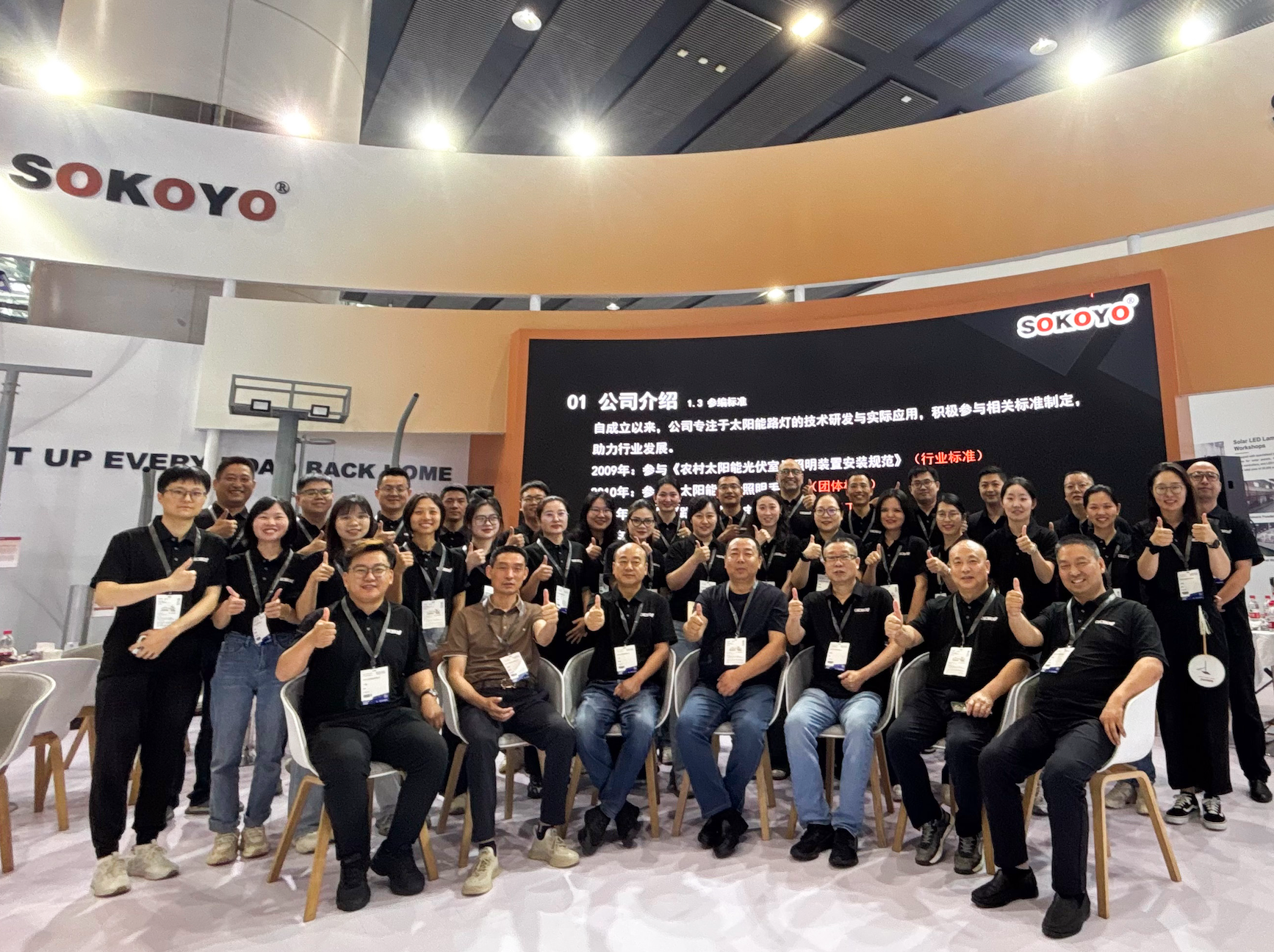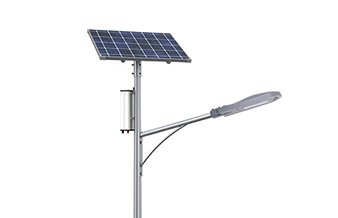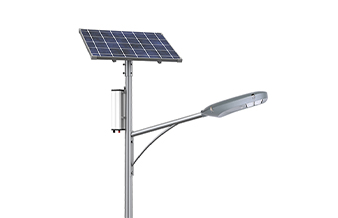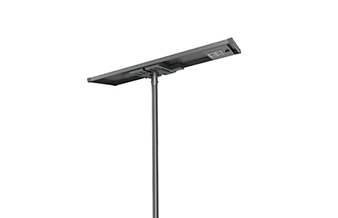

Experts at the DIALux booth, including Maria Toro-Ortiz, emphasized that as lighting systems become increasingly integrated and solar-powered, verifying performance and durability is paramount. For solar street light manufacturers like SOKOYO, achieving international standards across product lines (such as the KY-Y, KY-E, KY-F, and KY-D series) is essential to demonstrating professional capability in road lighting.
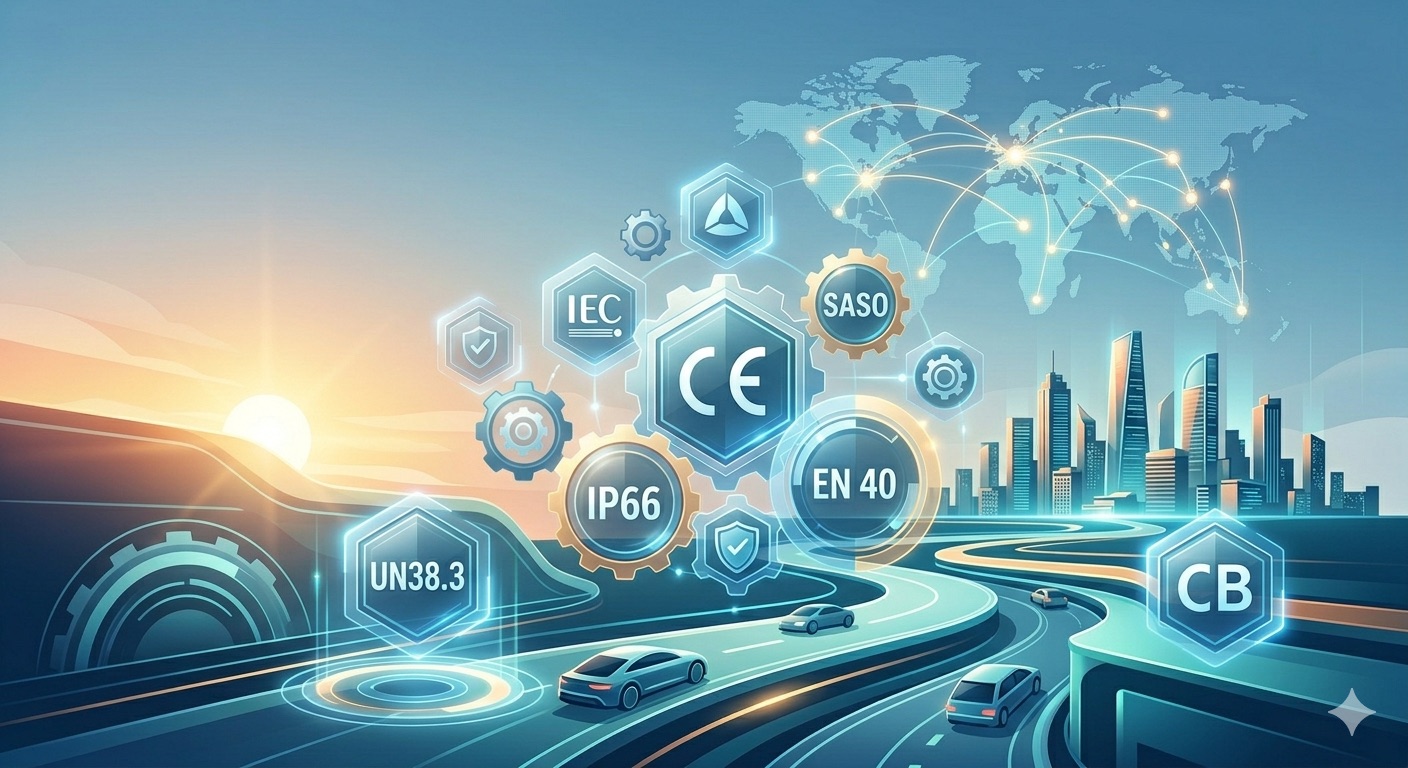
Image By Gemini
1. Lithium Battery Systems: Safety and Longevity
The lifespan of a solar street light is largely dictated by its battery. Lithium batteries are classified as Category 9 Dangerous Goods under the UN Model Regulations (the "Orange Book"). Consequently, certification covers both the cells and the battery packs to ensure safety during transport and long-term use.
Based on IEC 62133-2 standards and the CB Scheme, SOKOYO's lithium batteries undergo rigorous testing:
-Cell Level: Continuous low-rate charging, vibration, temperature cycling, external short circuits, free fall, thermal abuse (heat shock), and crush tests.
-Battery Pack Level: High-temperature casing stress, vibration, impact (collision), and overcharge protection.
By collaborating with authoritative third parties such as SGS and TÜV Rheinland and obtaining air/sea transport certificates (UN 38.3), the risks associated with international logistics are significantly mitigated.
2. Luminaire and LED Modules: Precision and Efficiency
The light source is the most direct indicator of a solar system's performance. For global market access, products must meet several critical benchmarks:
-CE & RoHS: Compliance with IEC 60598 standards and hazardous substance restrictions for the EU market.
-IP66 Rating: Ensures the core components (lithium battery, controller, and LED) are hermetically sealed against heavy rain and dust.
-LM-79 / LM-82: These reports provide verified data on total luminous flux, intensity distribution, and chromaticity. This ensures that the simulated lighting design matches the actual results on the road.
SOKOYO’s integrated and split solar street lights have passed IEC 60598-2-3 and IEC 60598-1:2014 testing, securing both CB and SASO energy efficiency certificates.
3. MPPT Charge Controllers: The "Smart Brain."
As the core management unit, the controller must meet strict CE-LVD (Low Voltage Directive) and EMC (Electromagnetic Compatibility) requirements. These certifications ensure that the controller manages charging and discharging efficiently without interfering with other electronic devices.
4. Photovoltaic (PV) Modules: Durability and Power
Solar panels are the power plant of the system. Their reliability determines the system's long-term stability.
-IEC 61215: A key standard for outdoor durability. It includes thermal cycling, damp-heat, humidity-freeze, and hail-impact tests. Post-test power degradation must be less than 5% of the initial output.
-IEC 61730: Focuses on safety. It covers dielectric strength, fire resistance, and structural integrity (Class II protection).
Currently, PV modules ranging from 30W to 410W have been certified through TÜV Rheinland, ensuring reliable power generation in diverse climates.
5. Lighting Poles: Structural Integrity (EN 40)
Lighting poles are critical structural components, especially in areas prone to extreme weather. The EN 40 standard is the European benchmark:
EN 40-5: Requirements for steel poles.
EN 40-6: Requirements for aluminum poles.
Core Test Requirements:
-Static Load Testing: Measuring deflection and deformation under self-weight, wind, and snow loads to prevent structural failure.
-Fatigue Testing: Simulating long-term alternating loads to ensure the pole does not crack or break over decades of use.
-Corrosion Resistance: Evaluating the protective coatings to ensure the pole survives harsh outdoor environments.
Conclusion
The trend observed at the 2026 Frankfurt Fair is clear: the market favors companies that respect standards and prioritize certification. By integrating ENEC 18, CB, IEC, and IP66 qualifications, manufacturers are moving beyond simple "assembly" to providing verified, high-performance solar lighting solutions. For global customers, these certifications provide a reliable technical basis for selecting products that perform consistently in the field.
Currently the last one.